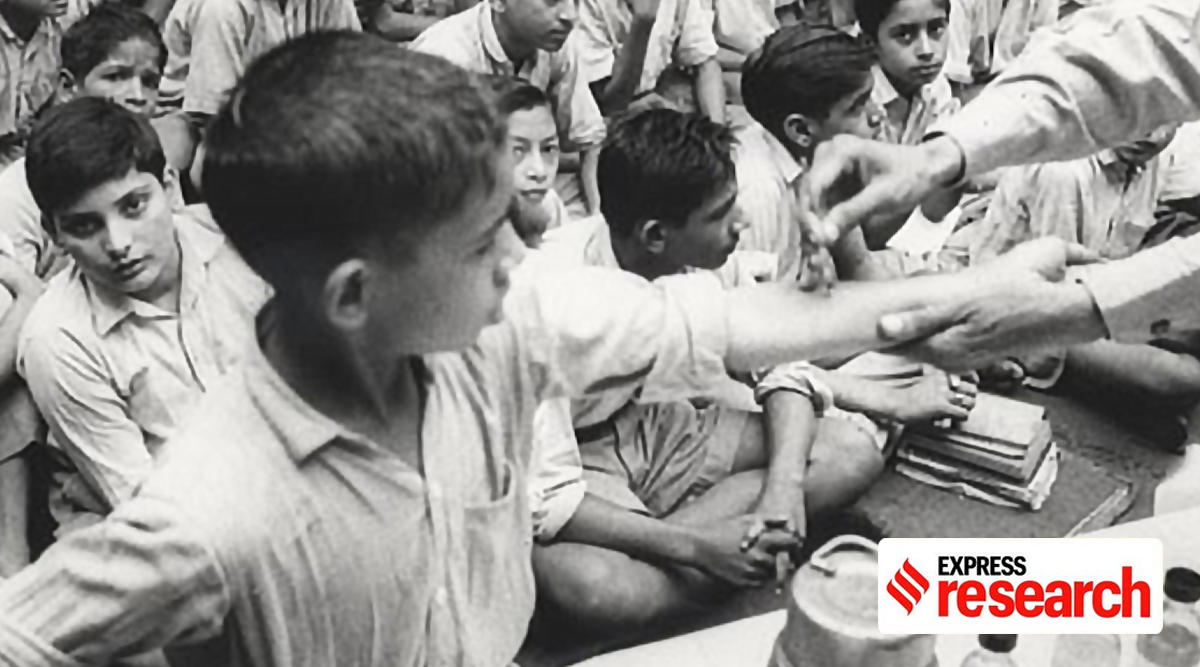
Dear reader, The vaccination drive for Covid-19 is currently going on in India. We thought it would be a good time to look back at two other major vaccination campaigns in the country- smallpox and polio. Although vaccination drives for both these diseases happened at two very different points in Indian history, and under distinctive socio-political circumstances, they provide important insights into the challenges, failures and achievements of large scale immunisation programmes in the country. In this story, we spoke to eminent health experts and medical historians of the country, and dug into the largely forgotten annals of inoculation drives to understand how the fundamentals of immunisation in India are driven by these two programs. The smallpox campaign started out in 1802 when India was under British rule. Vaccination became a means to extend colonial expansion, and a most striking feature of the campaign was the extensive use of Indian children. In the years to come, the nature of vaccination against smallpox and later polio altered with more involvement of international players and well planned strategies on dealing with vaccine hesitancy. Some of these plans worked well, some were only good to be forgotten. But what is evident from the past immunisation programmes in India is the strong role played by local community health workers as well as the effective coordination between the national, state, and district level health infrastructure. From Kingsway to Rajpath A revamped Central Vista is on its way in New Delhi and photographs of rubble strewn across the lawns surrounding India Gate have struck the emotions of Delhi residents who associate this space of land with memories of picnics and drives. For others, the lawns of India Gate is a vivid reminder of the many protests that took place here from the farmers protest of 1988 to Nirbhaya in 2012 and more recently the anti-CAA protests. Then there are those for whom India Gate is the perfect picture of political might best depicted in the annual Republic Day celebration here. By India Gate, the reference here is to Rajpath, or the long ceremonial boulevard that connects the Rashtrapati Bhawan to the Purana Qila, passing through the India Gate. When the British built New Delhi as its imperial capital in the early 20th century, this stretch of road was planned to be the equivalent of the Champs- Elysees in Delhi and was named ‘Kingsway’ after the British monarch George V who announced the shift of the capital in the 1911 Durbar. Yet for all its imperial significance, Kingsway remained rather lifeless in the years following the inauguration of the new capital in 1931. It is only in an independent India that Rajpath was wholeheartedly embraced by Indians. In this story we look at this fascinating journey from Kingsway to Rajpath and the democratisation of the British built capital that happened in the process. Streetwise Kolkata- Gumghar Lane For Streetwise Kolkata this week, Neha Banka dug into the history of a tiny, lesser known bylane in the heart of the city called Gumghar Lane. A hospital located in the area some 200 years back is what gives this street its name. But it was not a regular hospital, rather the very first quarantine centre of the city, built by the British to isolate those afflicted with contagious diseases. Wishing you a safe and pleasant weekend ahead. Sincerely, Adrija Roychowdhury | 




No comments:
Post a Comment